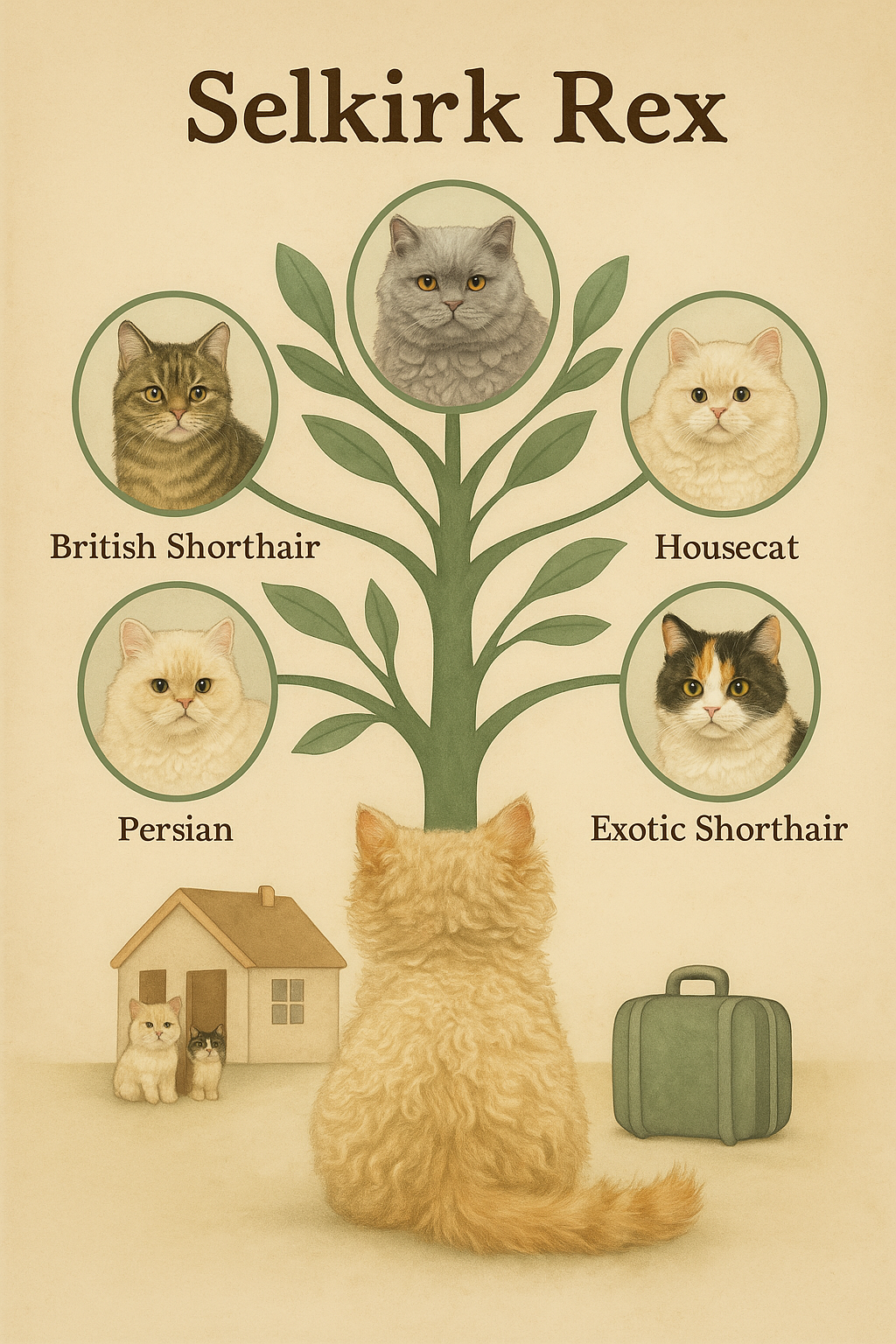
The Selkirk Rex origins
Where does this remarkable and uniquely original breed come from?
The unique history of the Selkirk Rex begins in 1987 in Montana (USA), when a blue tortie-and-white stray cat gave birth to a litter of five kittens. Among them, one kitten stood out for her unusual appearance. At nine weeks of age, this little female caught the attention of Jeri Newman, a Persian breeder, who decided to adopt her. She named her Miss DePesto, a playful reference to her affectionate and insistent behavior—she constantly demanded cuddles.
Jeri soon discovered that Miss DePesto’s mother also had a slightly unusual coat, with a faint wave at the tips of the hair. Miss DePesto herself was distinguished by curly whiskers, thick and wavy ear hair, and a body coat resembling a light permanent wave. Her appearance included a fine muzzle with a pronounced whisker break, high cheekbones, slightly slanted almond-shaped eyes, and a wide, flat space between two large ears. Her body, heavy and muscular like that of a Cornish Rex, rested on fine bones and long legs.
Noticing that all of Miss DePesto’s littermates had normal coats and that no other curly-coated cats were known in the area, Jeri suspected a new rex-type genetic mutation.
At 14 months of age, Miss DePesto was bred to a black Persian male, Champion Photo Finish of Deekay. On July 14, she gave birth to six kittens, three of which displayed the same curly coat. These results demonstrated that the gene responsible for this trait is dominant—unlike the genes of the Cornish Rex or Devon Rex—and that Miss DePesto also carried the longhair gene.
The breed was officially named Selkirk Rex, in tribute to Jeri Newman’s stepfamily. The Selkirk Rex was accepted into TICA’s “New Breed” program in 1990 and gained full championship recognition in February 1994.