
Our Red Program
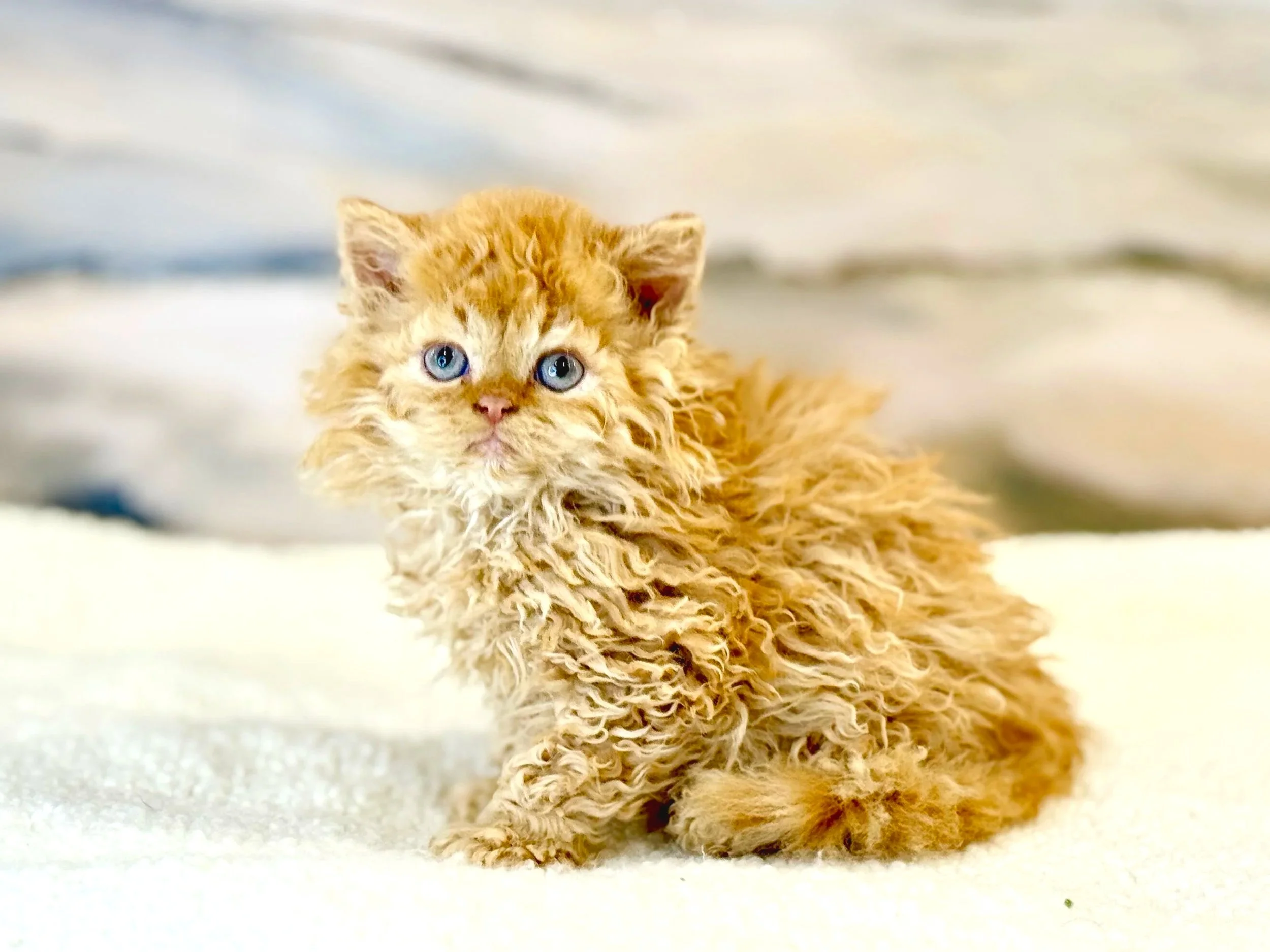
It all comes down to the X chromosome
In cats, red is carried on the X chromosome — and that changes everything.
A male has only one X, inherited from his mother. He is red or he isn't, with no in-between. And he passes that X only to his daughters: his sons receive his Y. A red male therefore makes every one of his daughters red or tortoiseshell, but can never give red to his sons.
A female has two X chromosomes. With one red X and one non-red, both colours are expressed together: that is tortoiseshell, a living mosaic of the two pigments. She passes red to roughly half her kittens, males and females alike.
Throughout this text, "tortoiseshell" includes "calico": a calico is simply a tortoiseshell whose patches are separated by white. Genetically, they are the same thing.
Red in our cattery today
four of our pairings already produce it, all with our studs: Amos and Nimrod, our Selkirk Rex males.
Pairing - Type of red produced:
Amos × Isha = Dense red with white
Amos × Judith = Dense red, solid coat — including our future stud
Nimrod x Judith = Dense red and dilute red
Amos × Esther = Cream and dilute calico — blue-cream and white
Yet Amos and Nimrod are not red: The red comes entirely from the mothers, all three tortoiseshell — the most direct demonstration of the X rule.
The mother alone decides the intensity. Amos and Nimrod being dilute themselves, they passes on only the dilute allele — never the non-dilute one. And dilution shows only when a kitten inherits two copies, so everything depends on the mother. With Isha, who does not carry it at all, every kitten comes out dense. With Judith, who carries one copy, it is one kitten in two — and our future stud is among them. With Esther, dilute herself, both parents pass the dilute allele: only cream can result (dilute).
These litters gave the cattery what it lacked: a red male.
Samson
Born in spring 2026 from our own lines, Samson Ginger Fire is a longhair Selkirk Rex in dense red. Full genetic testing tells us exactly what he passes on: he carries chocolate, which his father could not give; he carries non-dilute, so true deep red and not only cream; he is longhair and carries no white.
He will enter breeding at maturity, once his full cardiac screening is complete.
His four pairings
× Esther (blue tortoiseshell) — Females: red, cream, tortoiseshell or blue-cream. Males: roughly half red or cream. No white, longhair, and 100 % curly, as Esther carries the curl in double.
× Isha (chocolate tortoiseshell van) — Females: red and white, or calico in chocolate or black. Males: roughly half red and white. Colours always dense, and every kitten carries white. One of our sources of calicos.
× Lydie (golden chocolate) — 100 % tortoiseshell daughters, chocolate or black, dense, no white, golden possible. Males: chocolate or black, never red.
× Rakia (chocolate with blue eyes) — 100 % tortoiseshell daughters, solid, dense, no white. Males: never red. Rakia carries the Dominant Blue Eyes gene: roughly one kitten in two is born blue-eyed. Every DBE kitten from this line undergoes OFA-certified screening.
Esther and Isha are the only two who can produce a fully red female — she needs two red X chromosomes.
Why we keep tortoiseshell females
Without them, red would vanish from our cattery in a single generation. Samson makes every daughter tortoiseshell, but none of his sons inherits red from him: a male's red always comes from his mother. Tortoiseshell females are therefore the only vehicle carrying red forward on both sides at once.
Our goal: producing red on a larger scale. Today everything rests on three tortoiseshell queens — Judith, Isha and Esther. That is few, and it caps how many red kittens we can offer each year. Yet every one of Samson's pairings creates new carriers: even with Lydie or Rakia, who show not a trace of red, 100 % of the daughters are born tortoiseshell. By keeping several of them, we move from three carriers to a far broader group, and each will in turn give roughly half her kittens red or tortoiseshell — males and females. That is how red becomes a genuine line of the cattery rather than a happy accident.
Without white and in dense colour, by choice. White breaks up the patches and erases colour; a tortoiseshell without white shows both pigments whole, in sharp contrast. And a daughter without white passes none on: her own red kittens will be born in solid coats. Dense colour, meanwhile, allows deep red as well as cream — whereas a dilute female will only ever give cream.
Ultimately, pairing one of these daughters with Samson or Nimrod and his descendants will open the door to a wide variety of red Selkirk Rex kittens on a regular basis.