

Frequently asked questions
Adoption · Health · Shipping
Selkirk Rex · Devon Rex
These are the questions we are asked most often, and our answers exactly as we give them by email : direct, with no promise we could not keep. If yours is not here, write to us — that is usually how this page grows.
The breeds
What is the difference between the Selkirk Rex and the Devon Rex ?
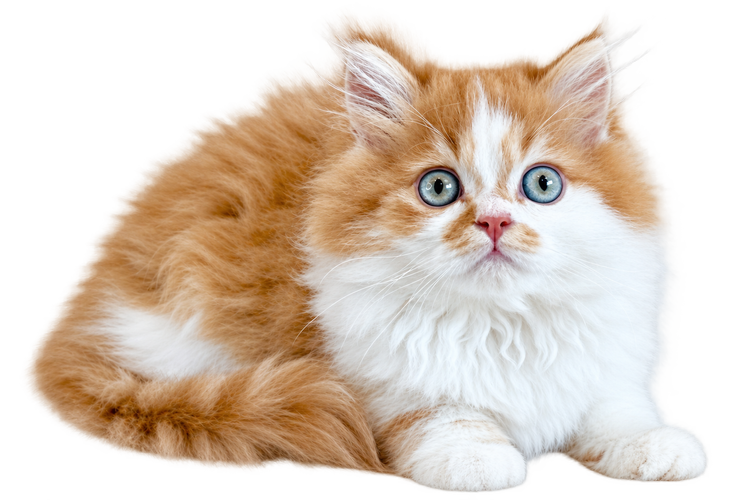
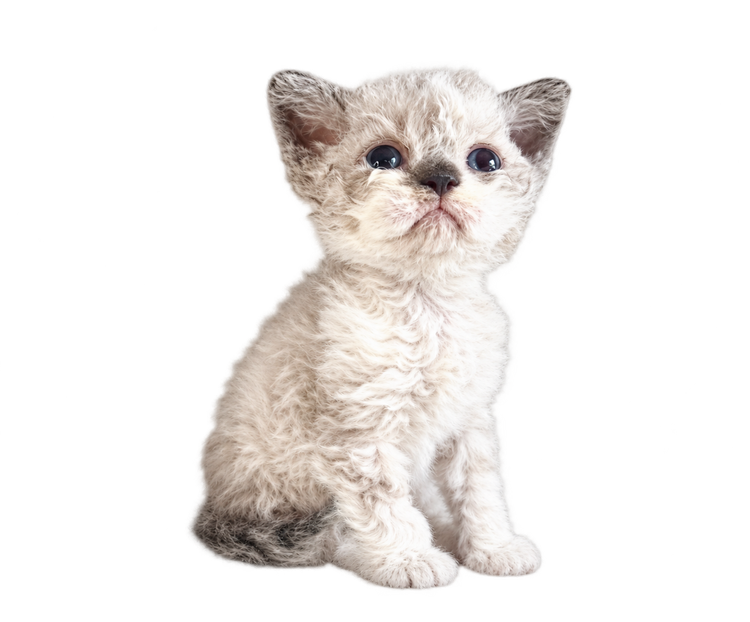
Both are curly, and that is about all they have in common. The Selkirk Rex has a sturdy, rounded body and a dense coat — curly or wavy depending on its genetic expression — over almost the whole body ; he is a calm, patient cat who follows you without imposing himself. The Devon Rex is finer and lighter, with large ears and a short wave close to the body ; he is quick, playful, constantly engaged with his humans. The choice is rarely made on looks : it is made on the pace of life you want at home.
Are the Selkirk Rex and the Devon Rex hypoallergenic ?
No breed truly is, and that needs to be said plainly. The allergen involved is Fel d 1, a protein of the saliva and the skin — not the hair. That is why a curly or hairless cat solves nothing in itself, and why two cats from the same litter can affect the same person differently. That said, many allergic families live very well with our cats. To find out what it means in your case rather than in the abstract, we have offered an at-home test kit since 2016, whose reliability we estimate at roughly 95 %.
Are these cats suited to children and to other animals ?
Yes. We chose these two breeds in particular for their balanced temperament and their great adaptability to every member of the family, from the youngest to the oldest. Our Selkirk Rex kittens take part as volunteers in our animal-assisted therapy sessions in seniors' residences : a cat doing that work has to stay settled in an unfamiliar place, tolerate handling, and go towards strangers without fear. Getting along with a dog or a cat already in the home depends above all on how the introduction is handled in the first few days, and we guide you through it.
What is a Selkirk Rex with dominant blue eyes (DBE) ?
DBE stands for Dominant Blue Eye : a dominant genetic trait that gives blue eyes to a cat that is neither Siamese nor white. We work jointly with the Blue Eyes Directory, the international project that traces these lines across breeds, and we apply in-house the genetic rules recognised to date. Breeding is done only DBE to a cat that is neither DBE nor latent — never DBE to DBE, because the documented risk comes from the pairing and not from the cat itself. We carry out targeted screening where it is possible, we establish status through phenotype and line tracing, and we register entire litters, not only the blue-eyed kittens. Every DBE kitten undergoes OFA-certified BAER hearing screening, and the result is disclosed in the contract with an appendix setting out what is known and what is not. The science on this trait is still evolving : that is what justifies our caution.
Adoption
You have three lists. Which one concerns me ?
The information list, free and without commitment, brings you cattery news and announcements of upcoming litters. It reserves no place, and it is rare for a kitten to be offered directly from it. You are looking, without committing. The advance notice list is free as well, with no deposit and no limit on places : it is the step that precedes joining the priority list. When kittens are selected by the families on the priority reservation, places open up and those on the list receive a group email notice. You are getting ready, letting your adoption plan mature. The priority list, finally, holds fifteen families, with a signed priority reservation contract and a $500 deposit deductible from the price, valid for twelve months. You are ready : the adoption takes shape.
How is a place on the priority list secured ?
By two steps, in this order : the priority reservation contract signed, then the deposit received. The place is held at that moment, not before. Places go to motivated, prepared families who complete both steps. There is no automatic rank and no race : nobody moves up from one list to another on their own, and no place is reserved in advance on the advance notice list.
How much does a kitten cost ?
A Selkirk Rex is $3,000 CAD and the Devon Rex starts at $3,000. A Selkirk Rex or a Devon Rex with dominant blue eyes starts at $4,000. Breeding rights range from $6,000 to $8,000, except for our DBE and latent lines, from which we sell no breeding rights at all. We accept Interac e-transfer, credit card, PayPal, cash and international wire transfer.
What is included with the kitten ?
Spaying or neutering, except in the case of a breeding cat, the microchip, vaccination, deworming, registration, the veterinary examination, the contract, the kitten's own genetic results and his parents' testing, along with thirty days of Trupanion insurance. Added to that is a health guarantee with two years of hereditary and congenital coverage, which is considerable and rare in this field.
At what age does the kitten leave the cattery ?
Later than in many catteries, and deliberately so. Weaning takes roughly twelve to fourteen weeks, and we consider the period from eight to thirteen weeks critical to a kitten's development : that is when he forms his personality alongside his mother, by imitation. We neuter our kittens at three months, and they leave the cattery within the following five to seven days. For the Devon Rex, far smaller in size, a month generally has to be added to those timelines.
How are kittens matched to families ? May I choose mine ?
Kittens are presented to families once they are old enough for us to assess their health, temperament, coat and DNA results. We never promise a particular kitten before that stage : it would commit you to a cat we do not yet know ourselves. Families on the priority list receive the selections according to their rank and may pass their turn as often as they wish.
May I visit the cattery ?
No, and we are unbending on this. A visitor can carry in, without knowing it — on clothing, shoes or hair — agents that spread very quickly through a cattery and are long and costly to eliminate : giardia, tritrichomonas, feline herpesvirus, coccidia, ringworm spores. We have invested heavily in decontamination equipment precisely to avoid that. Instead, we produce short, regular videos of the kittens in their own surroundings, and families on the priority list have live access to the nursery cameras, twenty-four hours a day. A first meeting would be misleading in any case : unlike a puppy, a kitten does not show his true personality to a stranger. The best indicator remains the breeder's daily observation, in a place where the kitten feels secure.
Do you sell kittens with breeding rights ?
Yes, but to breeders established outside Canada only. It is a different undertaking from a family adoption. A pair is not chosen on a whim : the two cats have to work together genetically, and that is settled on paper before it is settled by eye. Never the same litter, never the same sire, and as little overlap in the pedigrees as possible. We start from your pedigrees, we study what our programme can offer, then we come back with a precise recommendation, so that your first pairing starts with a low COI and genetic room to move. Kittens are registered with the CFA first ; for TICA, you receive the breeder slip and register them yourself, under your own prefix.
Health
What testing do you carry out on your breeding cats ?
Before any breeding, a DNA panel at Orivet, with confirmation at UC Davis for certain loci where that is necessary. We screen for PKD1, the polycystic kidney disease inherited from Persian lines : it is dominant, a single copy is enough to cause the disease, and any positive is removed from the programme without exception. We screen for progressive retinal atrophy, recessive, which leads to blindness : never two carriers together. We screen for pyruvate kinase deficiency, responsible for haemolytic anaemia. We establish blood type through the CMAH gene, to prevent neonatal isoerythrolysis, which can take an entire litter in a matter of hours. Added to that are coat type and a DNA profile with parentage verification. Lines and echocardiograms are verified before a breeding cat is even purchased.
And the heart ? Do you screen for hypertrophic cardiomyopathy ?
Yes, by echocardiography with a board-certified veterinary cardiologist, on every breeding cat, ideally every year. You should know that no valid DNA test for HCM exists in the Selkirk Rex : the known MYBPC3 variants are specific to the Maine Coon and the Ragdoll. The echocardiogram is therefore the only real screening, and that is precisely why it has to be repeated over time. In Québec, breeders generally work with a single cardiology clinic ; when the schedule pushes the appointment too far out, we run a SNAP proBNP at the veterinarian between two echocardiograms, and any abnormal result leads immediately to a full echo.
Is a flawless genetic panel enough ?
No, and this is the least discussed point in the profession. A cat can have an impeccable panel and still be a poor partner. Every pairing is calculated for its coefficient of inbreeding before going any further, with the aim of staying in the green zone. Testing tells you what a cat carries ; it is the pairing that decides what the kittens will inherit.
Is there a health guarantee ?
Yes. Every kitten leaves with a two-year guarantee against hereditary and congenital defects, to which thirty days of Trupanion insurance are added. Two years of coverage is considerable in this field, and it is a commitment we make because our health and breeding protocols were built and approved with specialist veterinarians.
Do you publish your laboratory reports online ?
No, and for a specific reason : reports published online get copied fraudulently, and it is a real problem in this field. We pass them on to adopting families along with their own kitten's genetic results.
Is your cattery regulated ?
On three levels. Municipally, the Ville de Saint-Sauveur adopted a resolution covering our property. Provincially, we hold an active MAPAQ permit, with surprise inspections up to date. And voluntarily, we hold ANIMA-Québec certification : our facilities, our sanitary protocols and our records have been inspected and verified, not merely described on a website. Our cats are also registered with TICA, The International Cat Association, and with the CFA, the Cat Fanciers' Association — registries that record cats and pedigrees, not premises.
Shipping
Do you ship kittens outside Québec ?
Yes, anywhere in Canada, to the United States and internationally. Depending on the destination, the kitten travels accompanied by a nanny or as cargo. Hand delivery is done by road only.
How much does an international departure cost ?
The cost is always presented in three separate blocks, never as a single amount. First the kitten himself. Then preparation and transfer, $500 CAD in addition for any departure abroad, covering the rabies vaccination required for export, the international veterinary certificate and transport to the broker. Finally the air transport itself, quoted by the broker and covering the nanny or the cargo, the crate and customs formalities ; that quote is valid for roughly twenty-four hours only, because fares and nanny availability change constantly. If your country requires FAVN serology, it is added, with a significant cost and delay.
What documents are required ?
A health certificate and rabies vaccination compliant with the requirements of the country of arrival, an endorsed international veterinary certificate, an EIDAP microchip implanted in the buyer's name before any vaccination, and, depending on the destination, FAVN serology. We work with an IPATA agent and with the Canadian Food Inspection Agency, and we hold the required import and export licences.
How much time should I allow for an international departure ?
It depends entirely on the country of arrival : minimum age of the kitten, minimum interval between the rabies vaccination and boarding, FAVN serology required or not, additional vaccines. Those rules set the departure date, not the cattery. Serology lengthens the timeline appreciably. We verify your country's requirements before putting any date forward.
A question that is not here ? Write to us. We answer personally, and we would rather have a long conversation before an adoption than a misunderstanding after one.