
Selkirk Rex: Straight, Heterozygous, and Homozygous Coats — The Real Differences
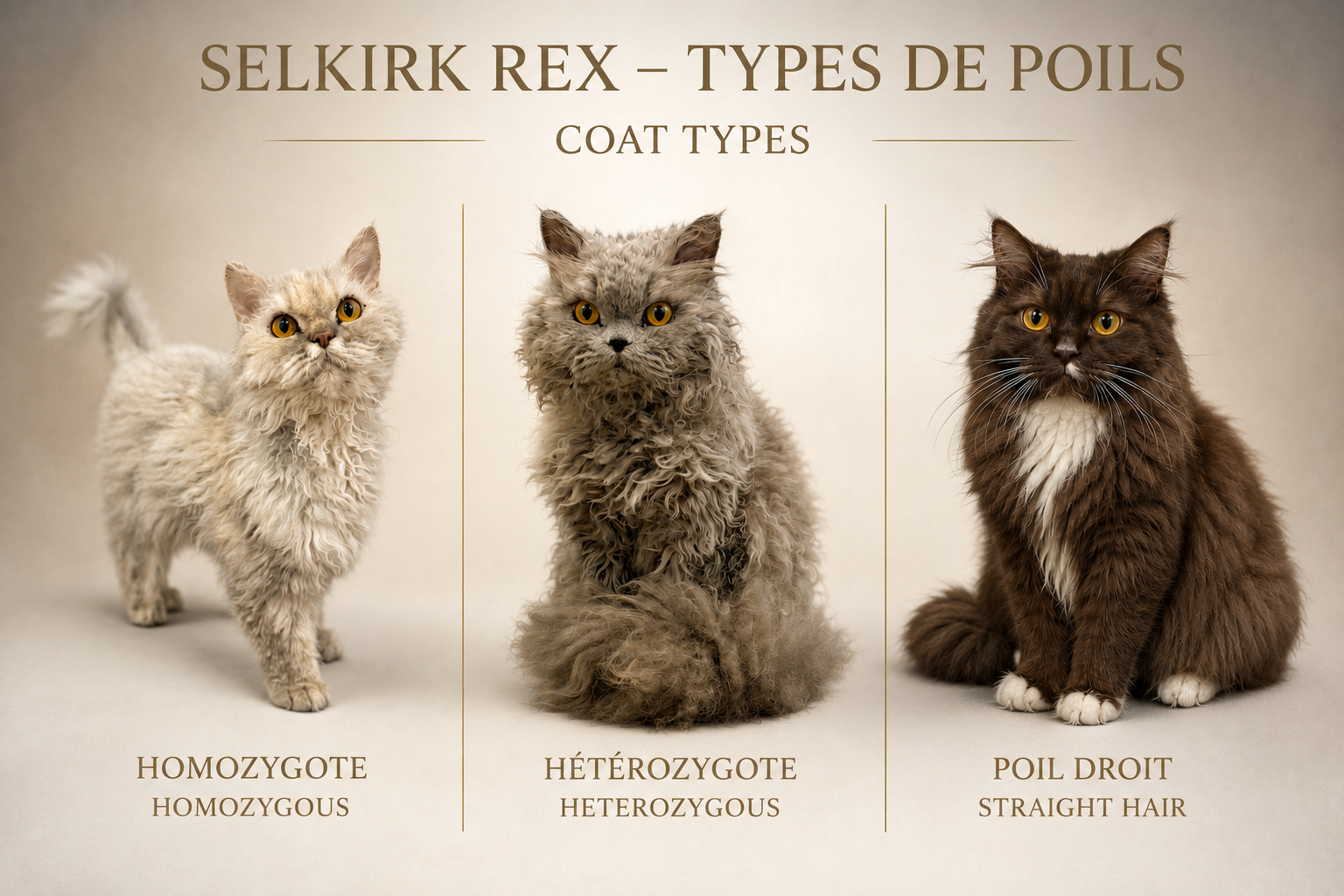
The Selkirk Rex is unique among curly-coated cats. Unlike the Devon Rex or the Cornish Rex, its curl is caused by a dominant gene (the KRT71 gene, also known as the Selkirk gene), which gives rise to three coat "types" within a single breed. Understanding these differences helps in choosing the right kitten for one's lifestyle — and in caring for each coat properly.
The genetics, in one minute
Each kitten inherits one copy of the gene from each parent. Depending on the combination, three profiles emerge:
Straight coat (Selkirk Straight) — two "straight" copies (sr/sr). The cat does not carry the curl, but remains a true Selkirk Rex in type, bone structure, and temperament.
Heterozygous curly (SR/sr) — one "curl" copy and one "straight" copy. This is the most common and most sought-after profile in the show ring.
Homozygous curly (SR/SR) — two "curl" copies.
The key point: the Selkirk curl shows incomplete dominance. This means the visible result isn't simply "curly or not" — it's a spectrum. The intensity of the curl varies with modifier genes, age (kittens curl, then "uncurl" at around 2 to 4 months, then re-curl at around 8 to 10 months), hormones, season, and coat length.
The practical consequence: you cannot reliably determine a cat's genotype just by looking at it. A strongly expressed heterozygous cat can resemble a homozygous one, and the reverse is also true. Only a DNA test (KRT71)confirms whether a cat is heterozygous or homozygous.
The straight coat (Selkirk Straight)
The straight-coated Selkirk has a normal, dense, soft coat with no curl. It is the easiest of the three to maintain: regular brushing is enough. However, its hair behaves like that of an ordinary cat — it sheds and disperses into the air more readily. It is a more airborne coat, one that ends up on clothing, furniture, and suspended in the room. For someone sensitive to allergies, this is the type to avoid first, precisely because the hair circulates freely (see the allergy section below).
The heterozygous curly
This is the Selkirk's signature: a soft, sheep-like curl, evenly distributed, with a plush feel. Expression varies from one individual to another — some heterozygous cats have an abundant, well-defined curl that visually approaches a homozygous cat, while others show a softer wave. Texture can vary too: some individuals have drier or coarser guard hairs than average, which is part of the gene's normal variability.
In terms of grooming, the heterozygous coat calls for a gentle hand: avoid excessive brushing, which breaks and undoes the curl. Occasional gentle combing, an occasional bath, and regular ear cleaning are generally enough.
The homozygous curly
The homozygous cat pushes the phenotype further: the curl is often denser and more abundant, sometimes with a more "cottony" or less structured texture. This is a perfectly healthy cat — in the Selkirk, the double copy causes no viability issues — but its coat requires more attention.
Because the KRT71 gene acts on the entire hair follicle, and not only on the hair shaft, the homozygous cat tends to produce more sebum (oilier skin and coat) and more cerumen (ear wax). The follicle forms a unit with the sebaceous gland and, in the ear, with the ceruminous glands: stronger expression of the gene often translates, in cascade, into more abundant secretions. In practical terms, a homozygous cat may need more frequent ear cleanings and, at times, slightly more regular baths to manage the oiliness of the coat.
It is worth noting that these secretions also follow a gradient: a strongly expressed heterozygous cat may approach this profile, with a drier coat and slightly more noticeable eye and ear secretions, without actually being homozygous.
Also important: abundant secretions should never be attributed to genetics alone. Unusual ear wax or increased eye discharge always warrant ruling out a medical cause (yeast, ear mites, allergies) with a veterinarian before concluding it is simply the "rex type."
What about allergies?
Let's be clear: no cat is truly hypoallergenic, the Selkirk Rex included. The main allergen, the Fel d 1 protein, is produced in saliva and the sebaceous glands, then deposited onto the coat during grooming — it is not "in the curl" itself.
On that basis, two honest points:
No study demonstrates that the homozygous cat is more allergenic than the heterozygous one. Even though the homozygous cat produces more sebum, there is no evidence that this results in more allergic reactions than a heterozygous cat. One should therefore not assume that an SR/SR is "worse" for a sensitive person.
The real practical difference lies in the hair that circulates in the air. The curly coat (heterozygous as well as homozygous) tends to retain dead hair and dander within the fur, whereas the straight coat sheds more freely and becomes more airborne. This is why, for an allergy-sensitive household, we steer toward a curly cat and avoid the straight coat — not because the curly coat produces less allergen, but because it disperses less of it into the environment.
Grooming in brief
In a few words: the straight coat requires the simplest care, regular brushing, but it is the most airborne. The heterozygous curly is content with occasional gentle combing, avoiding the over-brushing that undoes the curl, and holds its hair well. The homozygous curly calls for more sustained care — slightly more frequent ear cleanings and baths to manage its more abundant secretions — while also keeping its hair low-shedding.
In conclusion
All three types of Selkirk Rex share the same charm, the same affectionate character, and the same hardiness. The choice comes down mostly to lifestyle: the straight coat for those seeking the simplest care (outside of an allergy context), the heterozygous for the classic, balanced curl, and the homozygous for the most sheep-like fur, accepting slightly more diligent upkeep. And in every case, only genetic testing confirms a cat's exact profile — the eye alone is never enough to tell.
Mon Chat Mouton — Selkirk Rex cattery, Québec